

Mining Explosives Market to Reach $20.97 Billion by 2035 as Critical-Mineral Boom & Infrastructure Spending Drive Demand
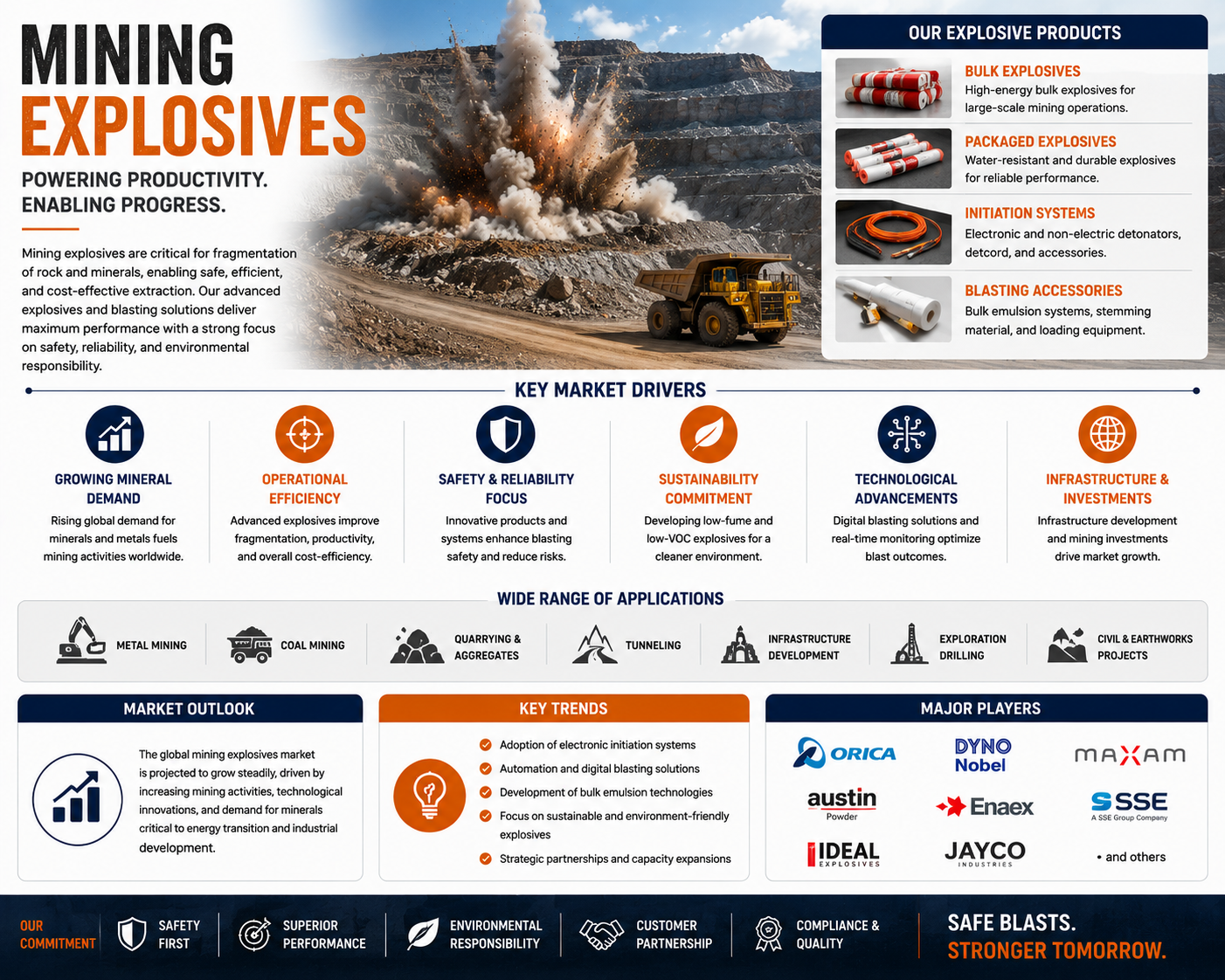
Mining Explosives Market
Asia-Pacific held about 52% of the global Mining Explosives Market value in 2025.
EUROPE, TRINIDAD AND TOBAGO, July 7, 2026 /EINPresswire.com/ -- Beneath the surface of the global energy transition lies a market that rarely makes headlines but underpins virtually every industrial ambition of the twenty-first century: mining explosives. Without commercial blasting products, there is no lithium for batteries, no copper for power grids, no aggregate for highways, and no coal for the emerging economies still building their energy foundations. According to a comprehensive report by Market Research Future (MRFR), the global mining explosives market reached USD 14.38 billion in 2025 and is projected to grow from USD 14.93 billion in 2026 to USD 20.97 billion by 2035, registering a CAGR of 3.85%. Two converging forces anchor this trajectory: governments worldwide are accelerating critical-mineral extraction programs to supply lithium, cobalt, and rare-earth elements for battery gigafactories, while simultaneously committing over USD 1.2 trillion to infrastructure renewal programs that require large-scale quarrying.The Critical-Mineral Imperative: Explosives as an Enabler of Decarbonization
The most powerful long-term driver of the mining explosives market is the global scramble for transition metals. According to the International Energy Agency, in a net-zero scenario, the demand for nickel will quadruple and the demand for lithium will surge sixfold by 2030, necessitating significant new hard-rock mining capacity. Each greenfield lithium or copper project consumes 5,000 to 15,000 tonnes of bulk explosives per year during the stripping stage. Since 2023, the governments of Australia, Chile, and the Democratic Republic of the Congo have expedited approval for more than 60 critical-mineral projects, totaling an estimated USD 90 billion in capital expenditures. The mining explosives market's addressable volume is directly increased by this surge.
The IEA's Global Critical Minerals Outlook estimates that mine output of lithium must triple and copper output must rise by 50% before 2035 to meet net-zero targets. Each new large-scale hard-rock mine entering production adds 5,000–20,000 tonnes of annual blasting-product consumption, creating a structural demand uplift that is largely decoupled from traditional commodity cycles. This is a market being pulled by policy rather than pushed by price.
Infrastructure and Urbanization: The Quarrying Engine
While critical minerals capture the headlines, quarrying and construction aggregates represent a more immediate and geographically dispersed demand pillar. The U.S. Bipartisan Infrastructure Law budgeted USD 550 billion for roads, bridges, and tunnels, much of which requires aggregate output from quarries. India's Gati Shakti program channels approximately USD 120 billion into logistics routes that demand crushed stone and ballast. Quarrying activities typically burn 0.15–0.25 kg of explosives per tonne of rock produced, translating infrastructure funds directly into blasting-product demand.
The quarry and construction aggregates segment is set to grow at a 4.37% CAGR through 2035, the fastest among all application categories. This reflects the global scale of infrastructure investment, from Indonesia's expressway programs to Vietnam's port construction and Saudi Arabia's Vision 2030 mega-projects. For explosives manufacturers, quarrying offers the advantage of predictable, recurring demand tied to government budgets rather than volatile commodity prices.
Download Report Sample Copy with TOC: https://www.marketresearchfuture.com/sample_request/7169
Technology Transformation: From Commodity to Precision Service
The mining explosives market is undergoing a technological revolution that is reshaping its value proposition. Conventional shock-tube and fuse-based initiation is giving way to electronic detonator systems that offer millisecond-level timing precision, reducing ground vibration by up to 40% and improving fragmentation consistency. Electronic detonators held roughly 42% of the initiation-system segment in 2025 and are growing at a 4.62% CAGR, the fastest among initiation technologies.
Australia's New South Wales and Queensland states have enacted ground-vibration limits below 5 mm/s for blasts within 500 meters of occupied structures, effectively mandating electronic initiation for compliance. The European Union's revised Explosives Precursors Regulation tightens traceability requirements, favoring electronically logged systems. These regulatory shifts push operators to upgrade from non-electric systems, increasing per-blast expenditure by approximately 12–18% but reducing re-blast rates and community complaints.
Concurrently, mine-site emulsion plants are replacing pre-packaged cartridge supply chains, enabling operators to manufacture sensitized product at the bench and cut logistics costs by an estimated 15–20% per blast cycle. Several tier-one producers have invested over USD 500 million collectively since 2022 in digital blast-design platforms that integrate drill-pattern data, geology models, and real-time detonation analytics. The explosives producer is evolving from a commodity supplier to a technology partner.
Product and Application Landscape
Bulk explosives commanded approximately 69% of the mining explosives market share in 2025, driven by large-scale open-pit operations favoring emulsion-based products. Emulsion technology has gained ground over traditional ANFO in wet-hole conditions, as its water-resistant matrix eliminates the need for costly dewatering before loading. The shift toward deeper open-pit benches with higher water tables further accelerates emulsion uptake.
Packaged explosives are forecast to advance at a 4.25% CAGR, supported by growth in narrow-vein underground mining. As surface reserves deplete, global average stripping ratios have risen from 3.5:1 in 2015 to an estimated 4.2:1 in 2025, forcing deeper underground development in South American copper belts and African platinum-group-metal seams. These operations require specialized packaged explosives and precisely timed initiation, creating a product-mix shift that carries higher revenue per tonne.
Coal mining accounted for approximately 62% of the market in 2025, though its share is expected to plateau as thermal-coal output declines in OECD nations. The Powering Past Coal Alliance has pledged to phase out unabated coal power by 2030, and Germany decommissioned its final hard-coal mine in 2018. The U.S. Energy Information Administration anticipates a 25% reduction in domestic coal production by 2035. However, emerging-economy coal producers—particularly India and Indonesia—continue to expand output, partially offsetting OECD declines and sustaining global explosives demand.
Metal mining is emerging as the primary long-term growth driver at a 4.18% CAGR, with copper, gold, and lithium projects requiring intensive drill-and-blast programs during multi-year stripping phases.
Buy Now: https://www.marketresearchfuture.com/checkout?currency=one_user-USD&report_id=7169
Regional Dynamics: Asia-Pacific Dominates, Middle East & Africa Surges
Asia-Pacific dominates the mining explosives market with roughly 52% of global value, anchored by China's thermal-coal output and India's expanding limestone-quarrying sector. China remains the single largest national consumer, driven by annual coal output exceeding 4.5 billion tonnes and massive highway and rail infrastructure programs. India is the fastest-growing major market within the region, with limestone quarrying for cement production expanding at over 6% annually and the government's Pradhan Mantri Gati Shakti plan catalyzing unprecedented aggregate demand.
North America holds the second-largest share at approximately 18%, supported by copper and gold expansions in Nevada and Arizona, where over USD 14 billion in permitted copper-mine expansions are underway. Canada's Saskatchewan potash producers and Alberta oil-sands operators maintain steady consumption.
Europe accounts for roughly 14%, with demand centered on quarrying and tunnel construction. The Nordic countries stand out due to Sweden's LKAB iron-ore operations and Finland's emerging battery-mineral projects. Strict EU vibration and noise directives accelerate electronic detonator adoption, while the continent's thermal-coal phase-out gradually shifts the application mix toward aggregates and metal mining.
South America holds approximately 9%, with its trajectory closely tied to the copper and lithium extraction cycles. Chile and Peru collectively represent over 40% of global copper mine output, and new lithium-brine and hard-rock projects in Argentina's Salta and Jujuy provinces are adding incremental explosives demand. Brazil dominates the regional share at 45%, driven by iron ore and gold mining.
The Middle East & Africa is the fastest-growing geography, posting a projected CAGR of 4.31%, propelled by Saudi Arabia's Vision 2030 mining diversification and accelerating critical-mineral exploration across sub-Saharan Africa. Saudi Arabia's commitment to unlock over USD 1.3 trillion in untapped mineral resources under its geological survey program is creating a new demand center. Sub-Saharan Africa's critical-mineral exploration boom—spanning cobalt in the DRC, lithium in Zimbabwe, and metallurgical coal in Mozambique—is attracting multinational mining companies and, with them, substantial blasting-product contracts.
Headwinds: Regulation, Substitution, and Supply Security
The market faces meaningful structural challenges. Stringent environmental and safety regulations act as a drag on growth, with the EU's updated Seveso III Directive and Australia's Security of Dangerous Substances Act incurring compliance costs estimated at USD 3–5 per tonne of manufactured product. Following high-profile storage mishaps, numerous jurisdictions have passed tougher ammonium nitrate handling, storage, and transit laws, limiting supply responsiveness and raising working capital needs for producers.
Mechanical and continuous mining alternatives present a longer-term threat. Continuous miners, road-headers, and tunnel-boring machines are displacing drill-and-blast methods in select underground coal and soft-rock operations. In Australian longwall coal mines, mechanical extraction now handles over 70% of production tonnage, directly reducing explosive consumption. While hard-rock applications remain largely blast-dependent, incremental adoption of non-explosive methods presents a structural headwind.
Currency volatility in emerging-market economies adds short-term uncertainty, particularly in South America and Africa where mining investments are sensitive to exchange-rate fluctuations.
The Future: Digital Services, Alternative Chemistries, and ESG Integration
Looking ahead, the mining explosives market is poised for a business-model transformation. Digital blast-as-a-service models are emerging, where explosives producers package blast-design software, IoT sensor networks, and outcome-based contracts into subscription platforms that guarantee fragmentation and vibration targets. This model shifts revenue from commodity product sales to recurring service fees, potentially increasing per-customer lifetime value by 30–40%.
Hydrogen-peroxide-based emulsion formulations represent a promising alternative chemistry. Regulatory pressure on ammonium nitrate has spurred R&D into alternative oxidizer chemistries that offer a potentially lower-risk profile for transport and storage while maintaining comparable energy output. If commercialized at scale, these formulations could open new market segments in jurisdictions with restrictive ammonium nitrate policies.
ESG integration is becoming a procurement criterion. Scope 3 emissions disclosure under frameworks such as the IFRS Sustainability Standards will compel miners to report blasting-related carbon footprints by the late 2020s. Explosives companies offering lower-carbon formulations, reduced-NOₓ emulsion chemistries, and verifiable ESG scorecards will gain preferential procurement standing.
Autonomous drill-and-blast ecosystems are on the horizon. By 2030, autonomous haulage and drilling systems are expected to be operational at over 50 major open-pit mines globally. Explosives manufacturers that embed their electronic initiation products and real-time blast-monitoring sensors into these autonomous workflows will transition from commodity suppliers to integrated technology partners.
Competitive Landscape
The mining explosives market exhibits high concentration, with the top five companies accounting for an estimated 55–60% of global revenue. Major players include Orica Limited, Dyno Nobel (IPL), MAXAM, Enaex S.A., Austin Powder, Solar Industries India, AECI Mining Explosives, EPC Groupe, BME (Omnia Group), and Hanwha Corporation. Orica leads with an estimated 15–18% revenue share, distinguished by its wireless WebGen initiation system and BlastIQ digital platform. Competition centers on technology integration, supply-chain reliability, and long-term service contracts rather than pure price.
Recent developments signal the industry's direction. BME, a division of Omnia Group, introduced Innovex 300D in September 2024—a bulk emulsion for surface mining in wet conditions. In October 2023, Omnia Group partnered with Hypex Bio Explosives Technology to release a nitrate-free emulsion based on hydrogen peroxide, attempting to lessen environmental impacts compared to standard explosives.
Related Report
aluminum ingots market https://www.marketresearchfuture.com/reports/aluminum-ingots-market-23133
bamboo charcoal market https://www.marketresearchfuture.com/reports/bamboo-charcoal-market-23784
fluff pulp market https://www.marketresearchfuture.com/reports/fluff-pulp-market-25456
recycled plastic granules market https://www.marketresearchfuture.com/reports/recycled-plastic-granules-market-25902
india infrastructure construction market https://www.marketresearchfuture.com/reports/india-infrastructure-construction-market-48040
Market Research Future
Market Research Future
+1 855-661-4441
email us here
Legal Disclaimer:
EIN Presswire provides this news content "as is" without warranty of any kind. We do not accept any responsibility or liability for the accuracy, content, images, videos, licenses, completeness, legality, or reliability of the information contained in this article. If you have any complaints or copyright issues related to this article, kindly contact the author above.
